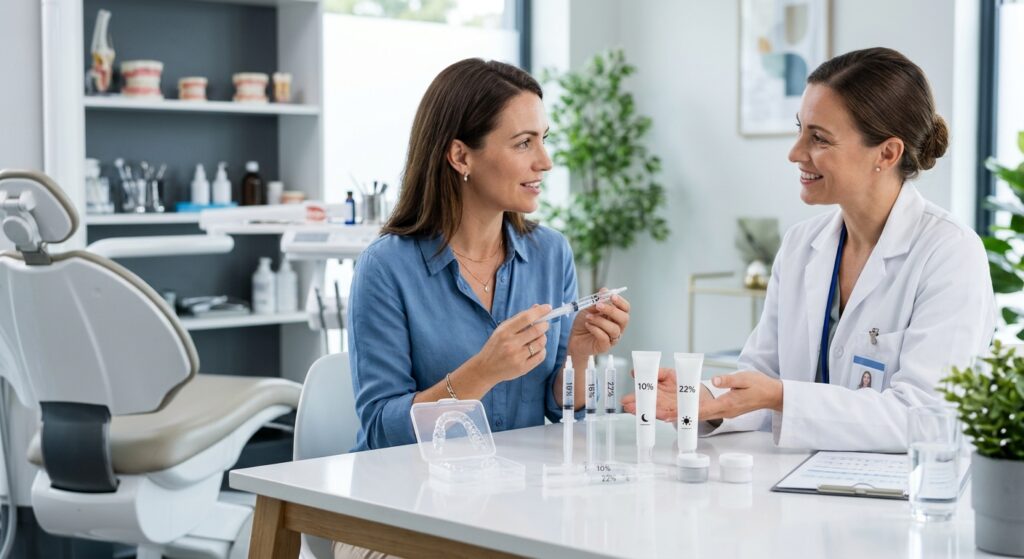
In-office teeth whitening remains one of the most requested and lucrative cosmetic treatments in modern dental practice. For years, systems like Philips Zoom 4 WhiteSpeed and Zoom Advanced Power have set the industry standard for rapid, high-impact results. However, many practice managers and clinicians face a common operational headache: rigid purchasing requirements tied to proprietary whitening kits.
Every standard Philips Zoom Chairside Light-Activated Whitening Kit comes with a prepackaged, limited-use light guide. Once your lamp registers four 15-minute whitening sessions, the Replace Guide prompt appears on the display. This built-in counter effectively locks your equipment until a new official guide is attached. As a result, clinics are often forced to buy expensive full kits just to obtain the single-use light guide – even if they prefer different clinical gel formulations tailored to specific patient needs.
Understanding how to select professional whitening gels independently gives your practice greater control over clinical outcomes, patient comfort, and supply costs.
Key Factors When Selecting Whitening Gels for Light-Assisted Bleaching
Choosing a clinical whitening gel for a light-assisted system involves more than peroxide concentration. The bleaching agent, desensitizing ingredients, and gel consistency all influence treatment performance and patient comfort.
Active Bleaching Agent: Hydrogen Peroxide vs. Carbamide Peroxide
Hydrogen peroxide (HP): A common choice for immediate, in-office whitening. Professional formulations often contain 25%–35% HP and can produce noticeable shade changes during a single 45–60-minute appointment. Results depend on the formulation, treatment protocol, and starting tooth shade – not simply on light exposure.
Carbamide peroxide (CP): Breaks down more slowly into hydrogen peroxide and urea. Although less common for short chairside sessions, lower-concentration formulations may suit patients who need a more gradual treatment approach.
Desensitizing Agents and Enamel Support
Tooth sensitivity is a common source of discomfort during and after whitening. Some professional gels incorporate ingredients to help manage sensitivity and support enamel remineralization:
Amorphous calcium phosphate (ACP): Supplies calcium and phosphate that can support mineral deposition on enamel and may help reduce temporary post-treatment sensitivity.
Potassium nitrate and fluoride: Potassium nitrate helps reduce nerve excitability, while fluoride supports remineralization and improves enamel’s resistance to acid.
Viscosity and Compatibility With Light Systems
Gel consistency affects how evenly the product stays on the tooth surface. A suitable viscosity helps maintain coverage and limits movement toward the gingival margins, although proper soft-tissue protection remains essential.
Some gels designed for light-assisted systems contain chromophores that absorb light at specific wavelengths, including blue or violet-blue LED light, typically around 400–505 nm. These ingredients are intended to enhance light absorption, but compatibility and clinical benefit depend on the specific gel and device. Light activation does not consistently improve whitening outcomes compared with peroxide treatment alone, so product selection should follow the manufacturer’s protocol and supporting clinical evidence.
Breaking Free from Proprietary Kit Lock-In with Dechip
Choosing the ideal gel formulation for a patient with sensitive teeth is simple in theory, but traditional equipment limitations can get in the way. If your lamp requires an official light guide after every four sessions, your gel choices remain constrained by what comes inside the factory-sealed box.
This is exactly why Dechip was engineered.
Developed by dental equipment repair specialists with expertise dating back to 2009, Dechip is a premium, reusable light guide accessory designed for Philips Zoom systems. It connects directly to your Philips Zoom 4 WhiteSpeed or Zoom Advanced Power unit in under two minutes, without tools, soldering, or permanent modifications to your lamp.
By keeping your lamp’s workflow status at Sessions 4 of 4, Dechip eliminates the restrictive Replace Guide cycle.
What Dechip Means for Your Clinic’s Bottom Line
- Freedom to Choose Your Whitening Gels
You’re no longer tied to buying bundled whitening kits just for the embedded electronic key. With Dechip, your clinic can independently source premium, clinically proven whitening gels or specialized formulas for sensitive patients – based on your clinical protocol.
- Lower Ongoing Costs
Traditional replacement cycles require clinics to keep paying for hardware chips built into single-use plastic guides. Dechip costs $399 as a one-time purchase, with no subscriptions. Clinics performing just one whitening procedure per month can recover their investment within six months, while busier practices may see a full return in as little as 90 days.
- A More Predictable Workflow
Keep your whitening appointments on track without delays caused by an out-of-stock replacement light guide.
- 10-Year Warranty and 30-Day Money-Back Guarantee
Every Dechip unit includes a 10-year hardware warranty and a 30-day money-back guarantee, so you can upgrade your clinical workflow with confidence.
Take Control of Your Whitening Practice Today
Your clinical decisions should be guided by patient care and product performance – not software-enforced hardware counters. Pairing your preferred professional whitening gels with the Dechip reusable accessory helps you manage costs while offering customized treatment options for your patients.
Ready to eliminate Replace Guide interruptions and take control of your supply budget? Order your Dechip today for $399 and enjoy more predictable whitening sessions.